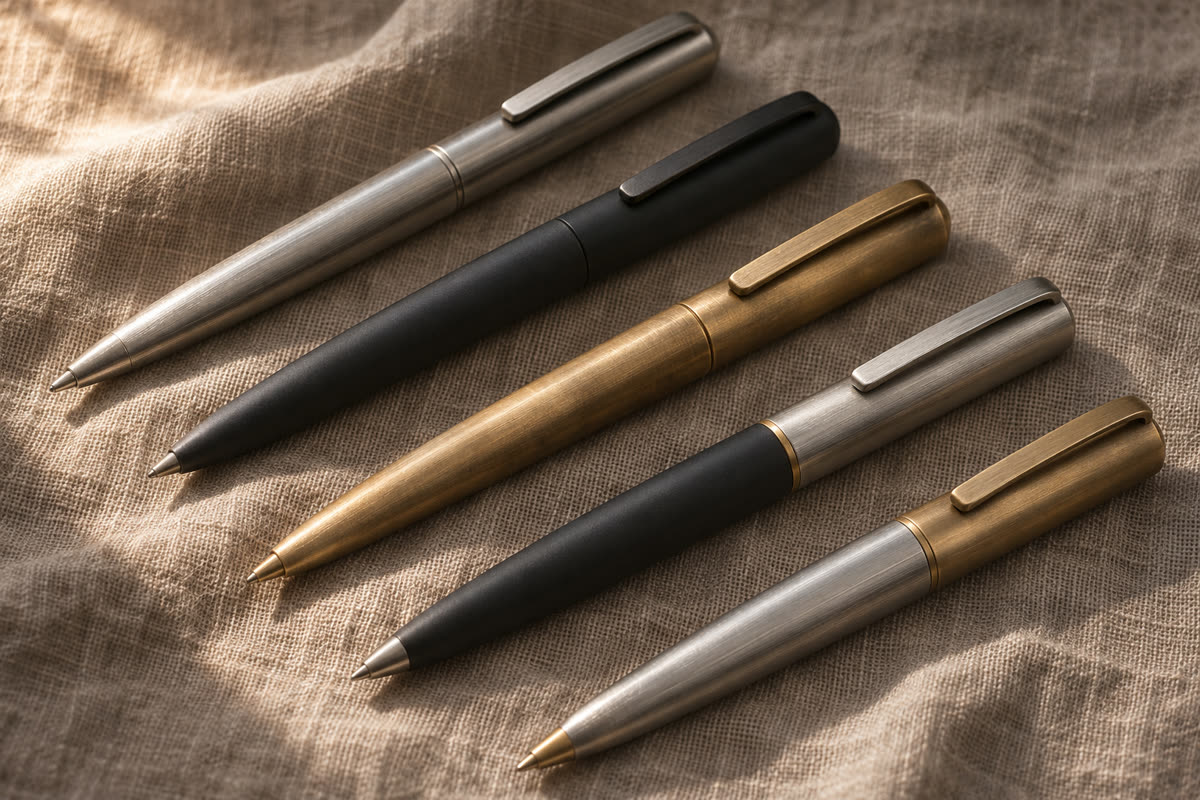
There is a version of this purchase that costs eleven cents a pen. There is another that costs ninety-five. On a spreadsheet, the first one wins by a factor of eight. In a hotel room, it usually loses.
This is not an argument that cheap pens are bad. It is an argument that the number on the quote is the wrong number to compare. What you are actually buying is not a pen — it is a quantity of future impressions, and the two options deliver wildly different amounts of it.
What actually determines whether a pen gets kept
Three things, in order of importance.
Weight. A pen below about 12 grams feels disposable in the hand. Guests do not consciously think "this is cheap", they simply put it down and forget it. A pen in the 18–28 gram range reads as an object, and objects get pocketed. This is the single biggest variable, and it is the one buyers most often overlook because it does not appear on a spec sheet.
Refill. A pen that stops working after a week is worse than no pen, because it teaches the guest that your brand is the thing that ran out. A standard metal refill costs a few cents more and lasts months. If a supplier cannot tell you which refill they use, that is your answer.
Surface. Matte and soft-touch finishes hold a logo cleanly. High-gloss plastic shows every fingerprint and scratches within a week, which is why glossy pens look tired in a room even when they are new.
The cost-per-impression calculation
Here is the arithmetic that changes the decision.
A basic plastic pen at $0.11 might be picked up twenty or thirty times before it is lost or binned. Call it 25 impressions for eleven cents, which is roughly $4.40 per thousand impressions.
A metal pen at $0.95, kept for four to six months on a desk, might be seen 200–300 times. At 250 impressions, that works out at $3.80 per thousand.
The expensive pen is cheaper. Not dramatically — but it is cheaper, and that is before you count the second-order effect: the metal pen is still on a desk in month six, and the plastic one has been gone since week two.
| Pen type | Unit cost | Typical impressions | Cost per 1,000 |
|---|---|---|---|
| Basic plastic, printed | $0.11 | 20–30 | ~$4.40 |
| Better plastic, soft-touch | $0.32 | 60–90 | ~$4.30 |
| Aluminium, laser engraved | $0.62 | 150–200 | ~$3.50 |
| Brass or steel, engraved | $0.95 | 200–300 | ~$3.80 |
The numbers are estimates, and they will shift with your property. But the shape of the curve does not: below a certain weight, you are paying for impressions that never happen.
Metal, plastic, or something else
Aluminium is the sensible default for most hotels. It is light enough to be inexpensive, heavy enough to feel real, and takes a clean laser engraving. Anodised finishes — matte black, champagne, deep blue — look more expensive than they are.
Brass and stainless steel belong in suites and signature rooms. They are heavier, they age visibly, and they suit a property that is making a claim about quality. They also engrave beautifully, because the mark is cut into the metal rather than printed on top of it.
Plastic is not automatically wrong. A well-weighted ABS pen with a soft-touch coating is a perfectly good midscale choice. What fails is the thin, glossy, sub-10-gram pen that exists mainly to hit a price point.
Wood is a niche choice and worth considering if your property has a specific story — a lodge, a vineyard, a heritage building. It photographs well and feels warm, but it is harder to keep consistent across batches.
What to specify before you ask for quotes
Most quotes come back incomparable because the brief was vague. Send these six things and the numbers will line up:
- Weight range you will accept, in grams. This single line eliminates most of the bad options.
- Material and finish — anodised aluminium, brushed steel, soft-touch ABS.
- Decoration method — laser engraving, pad print, or screen print, and how many colours.
- Logo position — barrel, cap, or clip. Barrel takes the longest names.
- Refill type and whether it is replaceable.
- Packaging — bulk, individual poly bag, or retail-ready.
If you are unsure about decoration, ask for a physical sample of the same finish with a test engraving. Digital proofs are useful for layout, but they will not tell you whether your logo disappears into a matte black barrel under room lighting.
How many pens a hotel actually needs
The most common over-order we see is pens, and it usually comes from a simple miscalculation: rooms multiplied by a guess.
A better starting point is room-nights, not rooms. A 120-room property at 70% occupancy produces about 30,700 room-nights a year. If a pen is taken on roughly 30% of stays, that is around 9,200 pens. If the property restocks per arrival rather than per departure, the number can be double.
Two adjustments matter. First, suites and club floors usually consume more, because guests there stay longer and take more. Second, a property with a conference floor will see a spike that has nothing to do with occupancy — delegates take pens from meeting rooms, not bedrooms.
Most hotels land between two and four pens per room per year. If your number is above six, you are probably restocking on a schedule rather than on actual consumption, and a simple monthly count from housekeeping will tell you which.
The reason this matters is cash, not pens. Over-ordering a cheap item is a small mistake that becomes a large one when it happens across four categories, because the stock sits in a store room for eighteen months and the design is out of date before it is used.
The mistake that costs the most
Buying one pen for the whole property.
Almost every hotel we work with ends up splitting the order: a lighter, simpler pen in standard rooms, a heavier model in suites and club floors. The cost difference across a mixed order is small, because the MOQ is per model rather than per property, and the effect is that the guest in a suite does not receive the same object as the guest in a standard room.
If you want to see what a mixed basket costs for your room count, the basket builder will total it. If you want the specifications in more detail, the metal pen range has the full ladder and finish list.
The short version: stop comparing unit prices. Compare how many times the thing will be picked up, and the decision usually makes itself.