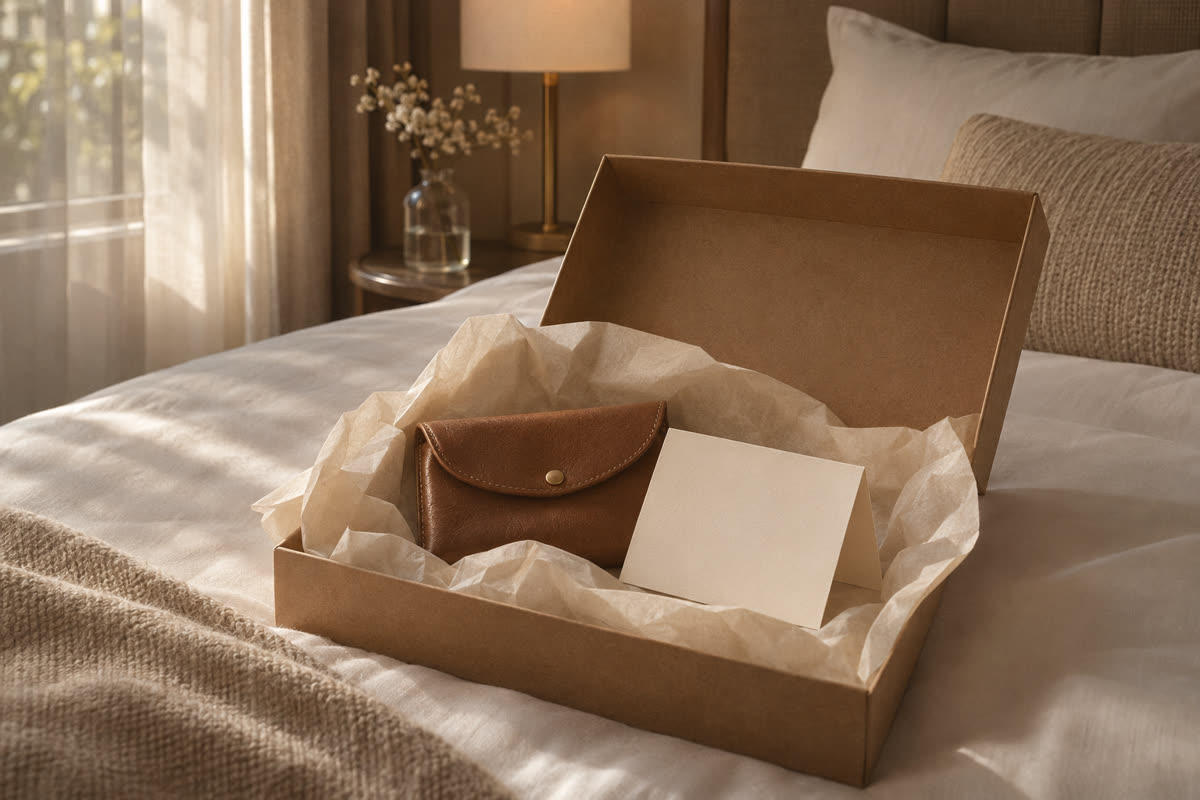
There is a number, somewhere around ten dollars, where a welcome gift stops being an amenity and starts being a gift. Below it, guests read the object as part of the room — nice, expected, forgettable. Above it, they read it as something someone decided to give them.
Getting that threshold right matters more than the specific item, because it determines whether your budget buys goodwill or just buys stock.
Why cheap welcome gifts fail
A welcome gift has one job: to signal that someone thought about this arrival. That signal is easily broken.
A five-dollar box containing a pen and a keychain is not a gift. It is the room contents, rearranged. The guest has already seen the pen on the desk. Putting it in a box does not change what it is, and guests are quick to notice when the "gift" is the same inventory they were given anyway.
The fix is not to spend more on the same items. It is to change the category of thing you are giving. A gift needs to be something the guest would not have received otherwise — a heavier object, a better material, something with its own packaging.
The three budget bands
In practice, welcome gifts fall into three bands, and each one suits a different tier of room.
Band one: $3–6 — the arrival gesture
This is the right band for midscale and select-service properties, and for standard rooms in larger hotels. At this level you are not trying to impress; you are trying to acknowledge. A small boxed set — a decent pen, a magnet, a printed card — works if the packaging is good and the items are not the ones already in the room.
The risk in this band is over-promising. Tissue paper and ribbon on a five-dollar set can read as trying too hard. Keep it simple: a clean box, one or two objects, no ribbon.
Band two: $8–15 — the considered gift
This is where gifting actually starts. At this level you can include something with real material presence: an insulated bottle, a leather travel set, a proper toiletry bag with a metal zip. These are objects a guest would buy for themselves, which is exactly the test.
Most upscale and boutique properties should be here. The per-unit cost is higher, but the quantity is small — welcome gifts go to a fraction of arrivals, not to every room.
Band three: $20+ — the VIP gesture
Suites, repeat guests, and anyone your front desk has flagged. At this level the gift is often bespoke: engraved, monogrammed, or built around a specific occasion. Volume is low and the cost per guest is high, which is the correct trade.
The mistake here is scaling band three to the whole property. It does not work financially, and it flattens the signal — if everyone gets the VIP gift, nobody is a VIP.
The cost framework that actually holds
Work backwards from the number of gifts you will realistically hand out, not from the number of rooms.
A 120-room property might give a welcome gift to 15% of arrivals — loyalty members, suites, special occasions. At 70% occupancy, that is roughly 4,600 gifts a year. At $11 each, the programme costs about $50,000. That number looks alarming until you compare it with what the same money buys in paid media, which is roughly five million impressions at typical social CPMs.
The gift programme, by contrast, produces fewer impressions but far better ones: a physical object, in a room, at the moment the guest is most receptive. It is not a like-for-like comparison, but it is the comparison your finance team will make, so it is worth having the numbers ready.
What to put in the box
Three rules, learned the hard way.
One object, done well, beats three done cheaply. A single leather luggage tag in a good box outperforms a pen, a keychain and a magnet in a flimsy one.
The card matters more than you think. A printed card with a handwritten name is the cheapest part of the set and the part guests mention. It is also the part most hotels skip.
Do not duplicate the room. If the guest already has a pen on the desk, the gift should not be a pen. If it must be, make it a visibly better one.
Three sample budgets
Concrete numbers make this easier to argue internally. Three worked examples, all assuming a 70% take-up among eligible arrivals.
| Property | Gifts a year | Per gift | Annual |
|---|---|---|---|
| 80 rooms, boutique | 1,800 | $12 | $21,600 |
| 150 rooms, upscale | 4,600 | $11 | $50,600 |
| 220 rooms, resort | 9,400 | $9 | $84,600 |
Two things stand out. The first is that the resort spends the most in total and the least per gift, which is the correct pattern — a resort has more arrivals and should not be putting a $15 box in every one. The second is that all three numbers are large enough to require a real budget line, which is where most gift programmes stall. A programme without a budget becomes an occasional gesture.
If the total is uncomfortable, the lever is not the unit cost — it is the eligibility. Dropping from 70% of arrivals to 40% cuts the programme roughly in half without changing what any individual guest receives.
Timing the order
Welcome gifts are seasonal in a way room items are not. If your programme runs through the holiday period, artwork needs to be approved by early September — packaging adds roughly three weeks to a standard production run, and December capacity disappears fast.
Our gifting range is built around four standard sets at fixed bills of materials, so you can price a programme without waiting for a quote. If you want to model a year of gifts against your arrival numbers, the basket builder will do it.
The short version: decide which band you are in before you choose the item, not after. The band determines the item, and the item determines whether the gift reads as a gift.