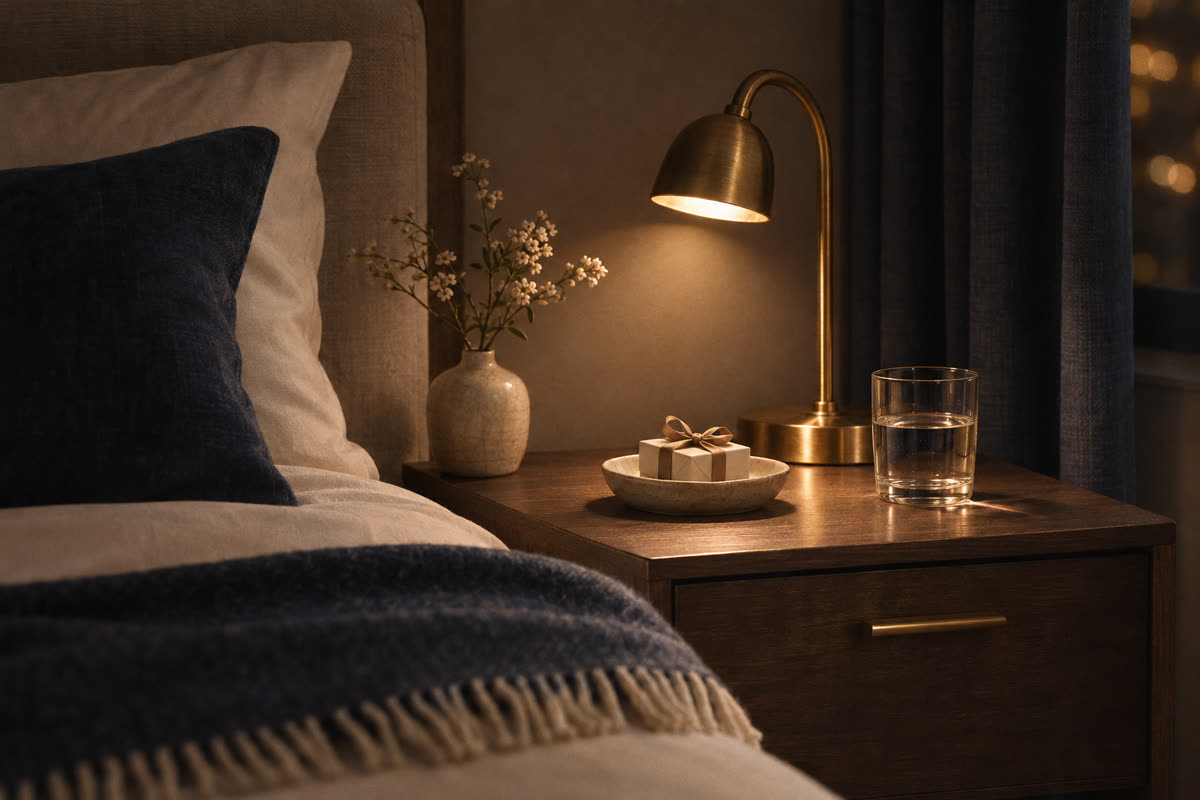
Turndown service has a strange status in most hotels. It is either a signature ritual that guests talk about, or a chocolate on a pillow that nobody remembers. The difference is rarely the budget. It is almost always whether anyone thought about what the guest is doing at that moment.
By the time turndown happens, the guest has usually been out for the evening. They come back tired, slightly warm, and not inclined to read anything. Anything you leave has about four seconds to register.
What the four-second window rules out
It rules out anything that requires reading. Cards with paragraphs, folded letters, menus — they get picked up, glanced at, and put down. If the message matters, it needs to be one line, or it needs to be delivered by a person.
It also rules out anything that looks like work. A survey, a feedback form, an upsell for tomorrow's breakfast: all of these convert a moment of arrival into an administrative task.
What survives the four-second window is something that is immediately legible as a gift. Small, already open or obviously openable, and placed where the guest's hands will land — the pillow, the nightstand, the foot of the bed.
Five turndown ideas that work
1. The single-object tray
A small ceramic or wooden dish by the bed with one object in it: a wrapped sweet, a small candle, a folded note. The dish is reusable and often goes home. The object changes with the season. Total cost per room is low, and the setup is fast enough for housekeeping to run at scale.
2. The folded throw
Not a gift, but the highest-impact turndown move available. A throw folded at the foot of the bed signals that someone prepared the room for the evening rather than just cleaning it. It costs nothing per night after the initial purchase, and it photographs beautifully — which matters more than it should.
3. The next-morning kit
A small bag by the door containing what the guest will need tomorrow: a tote for shopping, a luggage tag for the flight home, a compact mirror. Framed as "for tomorrow", it is genuinely useful, and it is one of the few turndown items that reliably leaves the building.
4. The weather card
A single line on a card — tomorrow's forecast and one suggestion. Cheap, fast, and it reads as local knowledge rather than marketing. The trick is keeping it to one line; the moment it becomes a paragraph it becomes collateral.
5. The return gift
For repeat guests only: something that references their last stay. This is the highest-value turndown move in the list and the one almost nobody does, because it requires the front desk to flag arrivals properly. A guest who has stayed four times and finds something that acknowledges it will mention it at checkout.
What to stop doing
Chocolates on the pillow. Not because they are bad, but because they are invisible. Every hotel does it, so it carries no signal. If you want the chocolate to register, put it somewhere unexpected — inside a folded napkin, in a small dish, next to a handwritten line.
Printed collateral. Spa menus, restaurant cards, loyalty programme brochures. Turndown is the worst possible moment to ask a guest to read about your facilities. Move it to arrival, when they have attention to spare.
Anything that needs explaining. If housekeeping needs a briefing to set it up correctly, it will be set up incorrectly at least a third of the time. Choose objects that are self-evident.
The operational constraint nobody plans for
Turndown runs at the busiest hour of the housekeeping day. Whatever you choose has to be placeable in under ninety seconds per room, by a team member who has already worked a full shift.
That constraint eliminates most elaborate ideas. It also explains why the tray and the folded throw work: both are one motion. Anything requiring assembly, wrapping, or positioning in multiple places will quietly stop happening by week three.
Briefing the team who actually does it
Most turndown programmes fail on the second week, and the reason is almost never the concept. It is that the instruction was given once, verbally, to a team working a shift that ends at eleven at night.
Three things make a programme survive.
A photograph, not a description. Pin a photo of the finished setup in the housekeeping office. "Place the tray on the left side of the nightstand" is ambiguous; a picture is not. Every property we have seen run turndown well has had a printed reference sheet.
A stock location that is not the store room. If the turndown items live three floors away, they will be skipped on busy nights. A locked cupboard on each floor, restocked daily, is the difference between a programme that runs and one that runs occasionally.
A named owner. Someone has to be responsible for the stock, the setup standard, and the weekly check. Without a name, it becomes everyone's job, which is another way of saying nobody's.
None of this is glamorous, and none of it appears in the guest's experience when it works. It appears very clearly when it does not.
How to test whether it is working
Two signals, both cheap to collect.
First, what disappears. If the tray object is gone at checkout, it was noticed. If it is still there, neatly arranged, it was not.
Second, what gets mentioned. Ask the front desk to note any unprompted comment about turndown for a month. Guests who notice tend to say so at checkout, and the specific words they use will tell you more than any survey.
If you want to build a turndown kit around items that actually travel, our guest room range has eight categories with the exposure profile of each. The basket builder will price a nightly programme against your room count.
The short version: turndown is not a marketing channel, it is a moment. Design for the four seconds the guest is actually present, and the rest follows.